
Sni-A-Bar Township is an inactive township in Jackson County, in the U.S. state of Missouri. It was annexed into the city of Kansas City, Missouri and is within the Kansas City metropolitan area.
History
It was established in 1834, named after Sni-A-Bar Creek. The township included Blue Springs, Oak Grove, and the village of Grain Valley.
It reportedly became William Quantrill‘s “principal rendezvous mainly because this area provided many bushwhackers and Confederate sympathizers”.
From 1913-1945, it was the site of a large demonstration farm called Sni-A-Bar Farms, the legacy of Kansas City newspaper mogul William Rockhill Nelson. It sustained the community through the Great Depression.


There were two Grist Mills in our little area. One was owned by Benjamin Major around 1834 and was just on the north side of Truman Road a little west of Crenshaw. I think I know where it was as you can see the raised area to cause the water to flow faster past the paddle wheel. You can see it if you look north as you cross the bridge. The other was owned by James Savage around 1826 and it would have been close to where Eureka Road and East R.D. Mize Road meets and a little west and north of that. South Necessary Road is the closest road, and by the way, Sater Necessary was the name of who owned the property there, not that it was a necessary road!! You would think someone would have found some of the old, discarded grinding wheels, and they may still be there, because in both places it is empty farmland. Below is a picture of what a Grist Mill would have looked like in our area.


The following is an excerpt from The Kansas City Star and was published on March 23, 1914.
“Out in the eastern hills of Jackson County, close to the Lafayette County line, Sni-a-bar creek wanders among well wooded hills of oak and hickory. It has never been anything but Sni-a-bar Creek, and the hills have been the Sni Hills since a time when the memory (of pioneer settlers) ran not to the contrary. And very rightly, too. For there’s a story connected to the Sni-a-bar country, which perhaps had not been heard by the man who wrote to The Star the other day demanding that the new highway to that portion of the county take the name East Wood Road rather than Sni-a-bar.
“Once upon a time—this story begins in the delightfully indefinite manner of fairy tales and other proper lore—once upon a time there was a Frenchman named Abar. At least, that was the way his name was pronounced. We do not know very much about him, except that he liked to poke the nose of his boat into waters he didn’t know, and that he was always filled with curiosity to know what lay around the next bend, or over the next hill.
“He set about out of New Orleans up the main highway of the Mississippi River. It must have been quite early spring, with a lingering edge of winter in the air as one rowed northward through the moss-hung trees. Ten men pulled the great boat, or polled it, or trotted along the bank with the cordelle or tow rope. So they came up the Mississippi and struggled through the turbulent, tossing, menacing gateway of the Missouri, where it poured out its yellow waters angrily.
“Then the long voyage up the Missouri was begun. How turbulent a stream. But consider, that it was all quite new and that around those castled cliffs. Abar must, without a doubt, have a little swagger in his swinging walk, and a touch of crimson in his costume. But gayety or not it was hard work making headway against the yellow stream, that was how Sni-a-bar happened to be discovered. Out of what is now Lafayette County, they came upon this quiet waterway.
“A little breathing space, a quiet time, a resting from the river. A sni is French for slough; Abar fancied he had struck a quiet loop of back water which would lead him again to the river in a mile or two, But, in a mile it became apparent that there was no slough, but a small stream. And so the board was turned and they polled back to the Missouri.
“He named the slough after himself. And he polled out of sight and hearing with a song and a laugh. Whatever he did, we don’t know, except that was of no great importance. There was without doubt some trading with the Indians, a little bland and roguish trafficking, And who can say how many trifling creeks may not have drawn the long boat’s prying nose from its course. You may safely let your fancy run riot with Abar, for there is little enough known of him that you’ll run no risk of contradiction.
“Sni-a-Bar Township—sometimes spelled with two hyphens, sometimes one and sometimes none—took its name, of course, from the stream, and so did the hills from which flow the tiny streams that make the small river. And really, wouldn’t it be a great shame to take the name away, with all its glamour of romance?
“East Wood Road, indeed! You might have an East Wood Road anywhere. But there’s only one Sni-a-Bar in the whole world, as far as the atlas can show.”
The Crenshaw Family
1840 The Census shows Nicholas Crenshaw (1784-1853) in Jackson County Missouri, married to Eleanor Green Lane and owning land. He owned slaves, 1 male aged 10 – 23, 1 female under 10, 2 females 10 – 23, and he had 4 farm hands. By 1850 he was in Jasper Missouri and it appears his children stayed in Jackson County in the Sni-A-Bar Township. The deed is dated 1833 and he owned land by the Missouri River as seen in the 1877 plat below the deed. But it shows Aaron Crenshaw owns it in 1877 so Aaron inherited it at some point around 1853.


Aaron Lane Hardage Crenshaw
I have zero proof, but I am guessing Crenshaw Road was named after the Crenshaw family for where the road ran through their property as well as Lowe Road and Strode Road were named after the land owners there. Below is the 1877 plat for this area. You can click on the pages to enlarge them.


Enlargement one above shows what would have become Truman Road with the little curve. The abutment of the east side of the bridge is still there and can be seen driving east on Truman Road to the right as you cross the bridge.
Enlargement two above shows where Crenshaw Road would have been. At that time it would have been a road just for the Crenshaw families. There was a road that ran from the Strode, Lowe and Lobb properties to the Thompson and Westerville properties. The ruts I am told can still be seen on the part that ran through A.W. Lowe property. My neighbors and I share the property that was owned by William M. Thompson.
Enlargement three above shows where the William M. Thompson now Parker house is. It was a two story house at one time. When I moved in, there was a large barn that was built probably sometime between 1840 and 1850. Legend has it that the James brothers stayed in that house one night and the horses were stabled in that barn. Which could have happened. Most of the residents were claiming to be Union but were Confederate sympathizers. Aaron’s son was a Private in the Confederate Army and a Quantrill Raider. More on that down the page! Where the two 90 degree turns are originally cut right across as you will see on the 1887 Plat. Here you can see where the Church, no longer standing and cemetery was, which is still there but in poor condition. The cemetery is called the Gibson-Russell Cemetary. Also in yellow blocks are Aaron Crenshaw’s children’s properties. About half of Aaron’s grandchildren went into the cattle business and moved west to California and Oregon and south to Texas and Mexico.

These Headstones Were Still Intact


THE FOLLOWING EXCERPTED FROM FIND A GRAVE:
Listed in Jackson County record as Gibson/Russell Cemetery as being in Section 15, Twp 49, Range 31 and being “on the West side of Crenshaw Road, 200 feet south of corner, and 1/3 mile north of Strode Road.” Additionally, the cemetery is about 100 yds north of 27th & Crenshaw.
This cemetery was also used to bury Civil War soldiers from a skirmish that took place near the Little Blue River, possible enroute to or from the Battle of Lone Jack. The story, as told to me by the property owner, is that there was a field hospital nearby, and as soldiers died, they were buried in this cemetery. In addition to the legible gravestones, there are about 12-15 graves simply marked with an upturned rock.
Restoration efforts were started in August 2011 along with transcription of legible headstones. Other online documentation refers to it as Russell/Gibson Cemetery.
It should also be noted that there are at least 10 gravestones that simply say “1864” to indicate unmarked graves of Civil War soldiers.
Please note: The cemetery is on private property.
End of Excerpt.
Could it be possible that the William M. Thompson house was the field hospital, since it was not burned? Most houses and crops were burned in this area, and people told to leave during General Order No. 11.
The next two paragraphs from The Topeka Capital-Journal
“Families were given 15 minutes to gather a horse and whatever possessions they could carry or put into a cart or wagon before they were exiled from the district.“
“There are many accounts of people burying silverware, jewelry and even mattresses thinking they could come back and get them later,” Monaco said.
You never know, you might just have some buried treasure in your yard!
My guess is the soldiers buried in the cemetery are from the CSA Price’s Missouri Expedition skirmish that happened on the Little Blue River as seen in map below. The cemetery would have been 3.75 miles from the battleground as the crow flies. The following excerpted from Wikipedia.
Little Blue (October 21)On October 20, Blunt’s retreating troops arrived on the Little Blue River, 8 miles (13 km) east of Independence. The Union force turned to engage the Confederates once again, using a strong defensive position on the west bank. However, Curtis ordered Blunt to return to Independence, leaving only a brigade under Colonel Thomas Moonlight on the Little Blue. The next day, Curtis changed his mind and ordered Blunt to take his volunteers back to the river. As he approached the stream, Blunt found that Moonlight’s brigade had engaged Price’s advance guard at sunup, burning the bridge as they had previously been ordered. Price’s main force had arrived and was fiercely engaging Moonlight’s men, who stubbornly guarded every ford in the area. Blunt immediately attacked, trying to drive Price back beyond the defensive positions he hoped to recover. A five-hour battle took place, in which the Union troops would force the Confederates to fall back, entrenching themselves behind rock walls, and await an inevitable counterattack. The outnumbered Federals compelled their enemy to fight for every inch of ground, but Confederate numeric superiority eventually forced the Yankees to retreat. The focus of the battle shifted to Independence itself.
Independence (October 21–22) As Blunt’s forces at the Little Blue withdrew westward toward Kansas City, they passed through Independence. Here Union rearguard units attempted to cover their retreat by engaging Price’s oncoming troops in the city streets. Brisk fighting raged through the town all afternoon, with the Federals slowly being pushed back. On the night of October 21 Price camped along an unfinished railroad cut just west of Independence, having taken the city itself. However, he was himself being pursued by 10,000 Union cavalry under Maj. Gen. Alfred Pleasonton, who caught up with Price in Independence at dawn the following day. Pleasonton crossed the Little Blue and attacked the city from the northeast, thus hitting Price in his rear as he undertook to continue his westward march. Two of Fagan’s brigades were mauled by the attacking Federals, being pushed back through the city toward the west where the main Federal force lay. Another Confederate brigade attempted to stem the onslaught on the grounds of what is now the Community of Christ‘s Independence Temple, but was practically annihilated by Pleasonton’s force. Nevertheless, a decisive victory eluded the Union in Independence. Marmaduke’s division engaged Pleasonton about 2 miles (3 km) west of town, managing to push the Federals back and hold them until the morning of the 23rd. The focus of activity now shifted westward from Independence to Westport, in modern Kansas City.


Civil War at the Little Blue River
Official casualty numbers are only known for a few units on each side. The 11th and 15th Kansas Cavalries and the 2nd Colorado Cavalry combined had 20 men killed. On the Confederate side, the 3rd Missouri Cavalry Regiment suffered 31 killed and wounded, while a total of three men were killed between Davies’s battalion and the 10th Missouri Cavalry Regiment. Among the Union dead was Major Nelson Smith of the 2nd Colorado Cavalry, while Confederate guerrilla leader George Todd was also killed. Todd had led a group of guerrillas during the battle; he was shot in the throat during the final stages of the action. Confederate surgeon William McPheeters reported that 10 wounded Union soldiers were left in Independence, and that civilians reported about 100 more had been taken with the Union troops during the retreat. McPheeters also noted seeing the bodies of dead Union soldiers strewn along the road from the river to Independence. Historian Mark Lause estimates that the Union may have lost up to about 300 men, and the Confederates more. Shelby later described the fight as the beginning of significant difficulties for his division during the campaign.
I am not sure yet, who could possibly be buried in the little cemetery, but here are the participants.
Confederate
5th Missouri Cavalry Regiment
4th Missouri Cavalry Regiment
10th Missouri Cavalry Regiment
3rd Missouri Cavalry Regiment
7th Missouri Cavalry Regiment
Davies’s Missouri Cavalry Battalion
Jackman’s Brigade
Clarke’s Brigade
Thompson’s Brigade
Nichol’s Missouri Cavalry Regiment
Harris’s Missouri Battery
Union
Moonlight’s Line
11th Kansas Cavalry Regiment
15th Kansas Cavalry Regiment
16th Kansas Cavalry Regiment
McLain’s Colorado Battery
2nd Colorado Cavalry Regiment
3rd Wisconsin Cavalry Regiment
Jennison’s Brigade
For a complete blow by blow of The Little Blue Battle, click on this link.
I have noticed that almost all people who migrated here were from Kentucky, Virginia and Tennessee, including the earlier settlers from the graveyard above. Almost all came here with their slaves. I found a informative website with information about the enslaved in our area. The man who held the most slaves in Missouri, over 200, was Jabez Smith. His mansion as seen below was torn down and William Chrisman High School now resides on his farm. Here is link to the website. On the road to freedom: Three stories of Jackson County’s enslaved.

Down the road at the Eureka/Crenshaw Road intersection is where Eureka School was. When I moved in, right at the intersection, the road split and the memorial was between lanes made of the brick from the chimney. It was quite large, then it was gone and replaced with a small stone marker in someone’s yard. The teacher that taught there was named Henry H.W. Parker (Any relation I wonder) and he lived near A.W. Lowe. See 1860 Census below.

Crenshaw Hardships
Henry Clay Crenshaw He was a member of William Quantrill’s raiders and was involved in the raid on Lawrence, Kansas in August of 1863. Henry spent all his money trying to stay out of jail for a period of time and had gotten financial support from James Pendergast. Henry’s marker was placed on Dec. 31, 2003. Henry is buried in Elmwood Cemetery in Kansas City.


KCPD Memorial Lest We Forget
Honoring the Fallen

Officer
Martin Hynes
Kansas City, MO Police Dept
EOW: Friday, Dec 30, 1881
Age: 39
DOB: 1843, Ireland
Tour of Duty: 1 year, 7 months (Sworn May 4, 1880)
Cause: Gunfire
Location: 10th & Main Streets
First KCPD Irish American officer killed in the line of duty
Officer Hynes was shot and killed while attempting to arrest a man for assaulting his wife.
On December 30, 1881 at approximately 5:00 pm, the police were called to the White House Saloon in regard to a disturbance. Officer Reilly was accompanied by Detective O’Hare and a Times reporter when they arrived to find a large crowd had collected. The officers contacted Maggie Crenshaw and her husband, Clay Crenshaw, in regard to the disturbance. Officers learned that Mrs. Crenshaw was planning to leave on the evening train to visit friends and family at Hot Springs, Arkansas. No arrests were made.
At about 8:30 pm on December 30, 1881, Officer Hynes was standing on the corner of 10th and Main Streets, when Maggie Crenshaw ran out of the saloon pursued by her husband. Officer Hynes, standing on the northeast corner of the intersection, hurried across Main Street to provide assistance where he confronted Clay Crenshaw on the sidewalk and took hold of Crenshaw’s sleeve. Mrs. Crenshaw reported that her husband had been been drinking for two days and had assaulted her. Crenshaw became angry with Officer Hynes telling him that it was a domestic matter and that he could whip any man on the force. Crenshaw jerked his arm away from Officer Hynes’ grasp and rushed back inside the saloon. While inside, Crenshaw retrieved a .45 caliber pistol from behind the bar, returned to the door flourishing the gun and entered the saloon’s vestibule. Crenshaw was heard saying that no police officer was arresting him in his own house. Crenshaw took deliberate aim and fired one shot at Officer Hynes, striking him in the right side of his chest. Officer Hynes staggered slightly and returned fire, firing once. As Officer Hynes advanced into the vestibule, four more shots were fired, three by Crenshaw and one by Officer Hynes. Officer Hynes then reeled and gasped three or four times before falling dead against the inner wall of the vestibule. Dr. W.H. Louis pronounced Officer Hynes dead at the scene. Hynes wounds consisted of a gaping bullet wound through the right breast, the second finger of his left hand was broken at the knuckle and his little finger had been shattered by a bullet. The flying bullets had splintered the door and one entered the side of the wall near the stairway to the north of the saloon.
Crenshaw was seriously wounded during the firefight, sustaining gunshot wounds to the neck and abdomen. He fled the saloon through the back door, then entered another saloon down the street and requested a doctor.
Crenshaw survived, was charged with Officer Hynes’ murder and tried on January 15, 1883. Following eight days of testimony and two hours of deliberation, the jury returned with a verdict of not guilty.
Officer Hynes was survived by his wife, Mary Ellen “Nellie” Hynes. He was 28 years old when he emigrated to the United States from Ireland in 1870. Officer Hynes joined the old “City Police” in 1871 and on April 15, 1874, became part of the Metropolitan Police Department when it was organized for the City of Kansas, later renamed Kansas City, Missouri in 1889. He was the first Irish-American police officer of the department killed in the line of duty and the second officer to lose his life in service to the city. Interred: St. Mary’s Cemetery, 2201 Cleveland Avenue, Kansas City, MO. The site of his death bears a marker donated by the Heart of America Emerald Society commemorating his sacrifice.
Article by Brent Marchant

Above is from 1875.

The first reunion of the men who rode with William Clarke Quantrill was held in September 1898 at Blue Springs, Missouri. They continued to hold annual reunions for thirty-two years, until 1929. The reunions were held in various locations, including Wallace Grove (the home of Mr. and Mrs. J.D. Wallace) in Independence, Mo.
This 1906 reunion photo was taken in Independence. Among the attendees was John Noland, first from right on the third row. Born a slave in 1844, he served as Quantrill’s hostler during the war and was used by the guerrilla commander as a scout and spy. Noland died in 1908.
Hiram J. George, second from right on the third row, was born in 1834. He fought as both a guerrilla and a regular Confederate soldier, serving at the battles of Independence and Lone Jack, in the raid on Lawrence, and at Baxter Springs. He died in 1911. At the age of 63 he had a son name Beuford J. George who is pictured in the photo above.
William W. “Buck” Fields, sixth from left on the first row, was born in 1844. He served with with the Missouri State Guard and with Quantrill. Fields participated in the siege of Lexington, the battles of Independence, Lone Jack, Cane Hill, Prairie Grove, and Westport, and in the raid on Lawrence. He died in 1937.
William H. Gregg, fifth from right on the first row, was born in 1838. He served as a lieutenant in Quantrill’s command, and fought at Independence, Prairie Grove, and Springfield. He also participated in the raid on Lawrence and in the destruction of General James Blunt’s command at Baxter Springs. Later in the war, Gregg left Quantrill and joined the regular Confederate army. He died in 1916.
John Hicks George, fourth from right on the first row, was born in 1838. He fought with Quantrill at Independence, Lone Jack, Prairie Grove, Lawrence and Baxter Springs. Later in the war he joined the regular Confederate forces and was captured by the Federals in 1864. He died in 1926.
Complete list of Quantrill Raiders at very bottom of page.
Image Courtesy State Historical Society of Missouri

This picture of attendees at the 1920 reunion of the surviving members of Quantrill’s band was published in the 1956 edition of William E. Connelley’s, “Quantrill And The Border Wars,” (Pageant Book Co., 1956). The picture was donated by Sim’s niece, Mrs. Forrest Gillam (Amelia Palmer) for the 1956 reprint of the 1910 William E. Connelley book. Sim Whitsett was identified by his niece as the man behind Jesse James Jr. (the man in the lower right corner with the light colored hat). However, in 1963 the Williams family identified the man as John W. Williams. The roll of men attending the 1920 reunion shows that Sim Whitsett was not present, but John W. Williams was. It is Peculiar that Miss Lizzie Wallace, who was on her porch standing behind the men, was completely removed from other copies of the picture.

This is the group photo from the 1920 reunion. The Kansas City Star on August 29, 1920 identified eleven as Quantrill veterans: A. F. Hayes, G. M. Noland, R. W. Colbern, J. C. Peters, J. M. Campbell; Morgan Maddox; Lee Stone; John T. Burns; William Patterson; Thomas Tatum; John W. Williams. The Quantrill veterans wore a special ribbon on their lapels, other guests did not. In this photo, Only five or six are wearing the ribbon. Some of the men were Confederate veterans, but not former Raiders such as John Williams, whom the newspaper incorrectly identified as a raider.

This photo is also the 1901 reunion in Blue Springs, Mo. Sim Whitsett was at this reunion and is probably in this picture. Also in the picture is Frank James. The first picture of the Quantrill veterans (Sim Whitsett was in attendance) was taken at the 1900 reunion. The picture is of a parade of the attendees on horseback. The 1901 is the first group photo in which the faces of individuals can be (barely) distinguished. Based on other photos, my guess is Sim is the man in the light colored shirt on Frank James’ right. Sim was reportedly one of the men that identified Jesse James’ body and he was reportedly a close friend of the James brothers.

This is the 1909 reunion. A list of Quantrill veterans who attended apparently was not published.

This is a cropped image of the 1910 Quantrill reunion with Cole Younger. Younger is the first man in front row on the right. Sim Whitsett is not listed as attending in 1910. Several men in the picture were Civil War veterans, but not former Quantrill Raiders. This photo is also from the Sons of Confederate Veterans web site (next panel).

This picture appeared in a 1911 newspaper article about that year’s reunion. Frank James is near the center of the photo seated on the left immediately behind the Quantrill portrait. Can you identify anyone as Sim Whitsett? This was apparently the last Quantrill reunion that Sim Whitsett attended. It was also the only reunion since 1903 where his name was published. The photo is from the Missouri Sons of Confederate Veterans web site www.missouridivision-scv.org/images
Below is a tintype of Hiram J. George from the 1860’s during the time he was with the Quantrill Raiders. He would have been roaming around this area and rode with Henry Clay Crenshaw and his Clay Bank Horse! Hiram and his brother, John Hicks George also a Quantrill Raider, lived in Oak Grove.

Aaron was married to Eliza Ellen Garner and he had property all over North and South West Missouri. Below is a land grant for one of the properties on Crenshaw Road as well as his Census and Slave Records. Aaron is buried in Lobb Cemetary. I put 3 pages of the 1870 Census to show everyone in this area. (You can click on the record galleries to enlarge the page you want to see.)


Aaron had quite a hard time with the Union Army in 1863. Please read the first two pages below. It will give you a sense of what Aaron went through during the Civil War. It is a condensed version and after that is the whole collection of original paperwork. Click on the page you want to enlarge.


Aaron went into business running US Mail to California in 1855. Below are the documents. Click To Enlarge.


1887 Plats Above – Click To Enlarge
Enlargement one shows the now Parker house and Eureka School.
Enlargement two 1887 Plat shows the road now called Truman with the bend still there where the old bridge was. And Crenshaw Road is now an actual road close to what it is today.
Enlargement three shows the now Parker house and the bend instead of two 90 degree turns as it is today.
Zachary Taylor Crenshaw lived behind my property or back then William M. Thompson’s property. I found a relative of the Crenshaw family on Ancestry and they were kind enough to send some pictures of Zachary in 1914 on his property. The house is not still standing that I can see on Google Earth. Click on images below to enlarge. The property lines on mine and my neighbor’s property are not correct but close enough on the Google Earth photo for reference.


Aaron and Eliza’s Children

Crenshaw Properties 1877


Above is Bell’s Map of Jackson County 1897. Truman Road then was called Spring Branch Road. William M. Thompson still owned my property. Click To Enlarge.


Above Plats are from 1904. My property would be located in Section 49-31. If you notice, there is a SELSA STATION. That is in a lot of the older plats also. It would have been located on Selsa Road situated next to the new Little Blue Parkway. That was the railroad station people would go to in the area to take the train. You can click on them to enlarge. The property is still owned by the Thompson family although the patriarch William has passed at this time. You can also see that Z.T. Crenshaw has sold most of his acreage by Lowe Road and kept a little for his house but also bought some land next door to William M. Thompson as seen in above Google Earth image.

William M. Thompson Property Lines Roughly as Shown 1877 & 1887 Plats. You can see the old wagon trail in the 1877 Plat. The ruts are still there as of 15 years ago when I was told about them.
William Malone Thompson


William and Lucinda (Webb) Thompson, natives of Tennessee and Alabama, respectively. They came to Missouri in 1846 and resided in Independence for the first year in 1847 before taking up the residence on the their farm on Crenshaw Road. The Thompsons drove to Jackson County with ox-teams, the trip from the South requiring ten weeks. William Malone Thompson and Lucinda Webb Thompson are buried in Blue Springs Cemetery. Click on above images to enlarge. Their oldest daughter Amanda Carlee Thompson married William Scarbourogh and as of 1910 census still resided on the farm. William and Lucinda would have passed on the farm.


WILLIAM SCARBOROUGH, farmer and stockman and owner of 135 acres of excellent farm land in Sniabar township, has worked his way to his present position by hard work and self denial. He was born in Kentucky, near Richmond, Nov. 8, 1857, and is a son of William Henry and Nancy Ellen (Stocker) Scarborough, both natives of Kentucky. William H. Scarborough was a son of Jonathan Scarborough, a native of Virginia and an early pioneer in Kentucky. William H. was born in 1837 and now resides near Frankfort, Ky. His wife, Nancy Ellen, is deceased. They were the parents of four children: John Milford, lives in Kentucky; Laura Minden, deceased; Mrs. Rose Elliot Mulberry, Kentucky; and William of this review.
William Scarborough came to Jackson County from his native state in 1881 and has resided in this county for the past 38 years with the exception of one year in Texas. He was accompanied by his wife and four children when he arrived in this county and his first employment was the railroad at $1.50 per day. He then moved west of Independence and worked for one year at monthly wages on the farm of Captain Hickman. His next employment was on a farm at Selsa, Mo., for one year. He then began farming on his own account and bought his first tract of land, the Thompson farm, in 1904. For a man who landed in Jackson County with a family of five and possessed of but $25.00 and his household goods, Mr. Scarborough had done remarkably well.
Mr. Scarborough’s first marriage was in 1875 with Miss Sarah Bryan of Kentucky, who died in 1890, leaving nine children.
Mr. Scarborough is a Democrat. He is a member of the M. E. Church, South, and is affiliated with the Odd Fellows and the Modern Woodmen.”


Above is the 1930 Plat Map. Enlargement Number One shows Truman Road and Crenshaw Road. The bend is still there for the old bridge. Notice the Crenshaws are starting to disappear. Number Two shows the south end of Crenshaw. Number Three shows where I think my property is in 1930. Hard to tell since the road is not the same as modern day or the person that drew up the plat did not get it right. As you can see, William and Lucinda have passed on and the farm is now in the hands of oldest daughter, Amanda Carlee Scarborough nee Thompson and her husband William Scarborough. They have sold off a small section of land at back to G.W. Lowe. In 1929 Amanda passes on the farm and William and older children still living on the farm in 1930 Census. By the time the 1940 Census is taken, William is in his last year of life and living behind his property on Lowe Road with his daughter and son-in law Lula and Homer Helm. The green line on enlargement two shows the path to his daughter’s house and his son lives next door. All the census records are above the 1930 plat maps. Click on them to enlarge. By this time I would imagine the farm is now in the hands of the Parker family.


Above is the 1939 Road Map of Jackson County.


Above are 1940 Tax Maps. Truman Road was called Spring Branch Road. The origin of what is now the segment of Truman Road east of Missouri Route 291 in Independence, was initially called Spring Branch Road, named after a nearby creek. On January 20, 1949, it was renamed Truman Road, and its ribbon-cutting ceremony was on December 15, 1953, which published a declaration that “Truman Road, representing a symbol of progress and a citadel of freedom, must be magnificently beautiful and rainbow colorful. 1949 would be when the old bridge was demolished and a new one put in to straighten the road. I do not see 23rd Street (78 Hwy) there where it would cross at the power plant. At the top of the map is Lake City Road. That would become 23rd Street. They would have had to construct the rest of it heading towards Independence in the 1960’s according to Wikipedia. 1940 Still using the old bridge to cross Little Blue. The two 90 degree turns on Crenshaw are now visible. Click To Enlarge.
Neighbors of Aaron L.H. Crenshaw
Lowe Family
Andrew was born August 29, 1828 in Amherst Virginia. His wife was Eliza Dillingham. If Dillingham sounds familiar, it is because her family also came here and has property all over the Sni-A-Bar township. His property backed up to mine and my neighbor’s property and went east to Lowe Road and Strode Road. The old wagon trail ran all the way through his property. South and next to his property was his brother John Mardonias Lowe, born October 4, 1842 and was married to Eliza Catherine Stayton. Next south property was owned by another brother named Calvin Van Buren Lowe, see picture below. He was born December 5, 1832 and was married to Mary Elizabeth Moore.

Manley Family
Not much about G. George Manley. My property is on part of his property. He came from Ohio and was born around 1832. He was married to Mary. He was to the south of the Thompson farm next door.
The now Stoneridge development sits on Mr. Manley’s land as well as the front 1/3 sits on G. Westervolt’s property. Mr. Manley’s house would have been there as seen on plat below from 1877.


Crenshaw Family
To the north of the Thompson farm, the property was owned by Aaron L.H. Crenshaw and children William Nicholas Crenshaw and Zachariah Taylor Crenshaw all the way to now Truman Road, then called Spring Branch Road. Below is a picture of William N. Crenshaw and family.

Westervolt Family
1877 Plat shows G. Westervolt as owning the property. But 1870 Census shows N. Westervolt owning the property and he is 12 years old. He is living with Mollie Westervolt who is 18 years old and Mattie Riman who is 16 years old and Gus Whaley who is 18 years old. My guess, G. Westervolt was the father and either died of natural causes or because of Order # 11 and his eldest son took over the farm. Their property was across the now Crenshaw Road from the Thompson farm.
Eureka Road
B.J. George lived next to William M. Thompson’s property just past Strode Road. His name was Ben J. George. See below the 1880 Census for him and the farmers on the now Eureka Road. Includes N. Poteet, Henry Etzenhauser, Thomas Lane Crenshaw, M. Chapman, Daniel Dewitt and James Steele families.


Before General Order # 11
Author
Although the name “Red Legs” is commonly conflated with the term “jayhawkers” to describe Kansas guerilla units that fought for the Free-State side during the Bleeding Kansas era or the Union side in the Civil War, Red Legs originally referred to a specific paramilitary outfit that organized in Kansas at the height of the Civil War. Union Generals Thomas Ewing, James Blunt, and Senator James H. Lane were all supporters of the group, and Kansas Governor Thomas Carney personally financed it for service. The Red Legs first joined together near Atchison, Kansas, under the command of Charles R. “Doc” Jennison and Captain George H. Hoyt, a Massachusetts lawyer who defended John Brown at his trial after the Harpers Ferry Raid. The men who joined the group called themselves the Red Legged Scouts and their stated purpose was to serve as scouts and spies for the Union Army. The Red Legs were never officially mustered into the Union Army and there are no formal unit histories; however, their deeds along the border became notorious among Missourians and notable among Kansans.
The Red Legs were a somewhat secretive organization of about 50 to 100 ardent abolitionists who were hand selected for harsh duties along the border. Membership in the group was fluid and some of the men went on to serve in the 7th Kansas Cavalry or other regular army commands and state militias. They are associated with a lesser-known group that called themselves the “buckskin scouts,” and they served as an auxiliary arm to regular troops, such as the 6th Kansas Cavalry on punitive expeditions into Missouri. The legendary James “Wild Bill” Hickok, then still just a teenager, William “Buffalo Bill” Cody, and fellow Pony Express rider William S. Tough are among the few individuals known to have served with the Red Legs. Buffalo Bill Cody admitted that as a member of the Red Legs, “We were the biggest thieves on record.”
Buffalo Bill Cody admitted that as a member of the Red Legs, “We were the biggest thieves on record.”
There are several versions of the story of how they earned the name and their reputations along the Missouri-Kansas border. One account of the legend claims that the men chose to wear tan or red colored yarn leggings to both distinguish themselves as a unit and to protect their legs while riding and marching through thick brush. Two stories from the Missouri side of the state line claim that in 1861, when Jennison and Hoyt led these men into Independence, Missouri, declared martial law, and forced the citizens to swear loyalty oaths, they also raided a local store and stole rolls of red carpet that they cut into strips to make a covering for their legs. Some Missourians claim the Red Legs stole red draperies and bolts of cloth from people’s homes and used that material to make their distinctive red leggings. In another tale, the men stole from a cobbler’s shop a supply of sheep hides that had been dyed red and precut to make boot tops. There is likely a grain of truth in all of these origination tales. Over the course of the war other groups of anonymous brigands from Kansas also wore red leggings on their raids into Missouri, much to the chagrin of a succession of Union Army commanders, who were charged with keeping peace and order along the border.
The Red Legs accompanied Jim Lane and the jayhawkers on a raid through Butler, Harrisonville, Clinton, and Osceola, Missouri, in September 1861, which left those towns and the farms along the way in a smoldering swath of ruin. When not raiding into Missouri, they patrolled for bushwhackers who made raids into Kansas. They held headquarters in Lawrence, Fort Scott, and at Six-Mile House on the road to Fort Leavenworth from Quindaro, Kansas. When a band of Missourians rode into Kansas to track down their stolen livestock, the Red Legs rounded them up and several Missourians were hanged. Illegal raids by the Red Legs eventually led Blunt to disavow them and all other paramilitary groups that defied legal authority. When Kansas Governor Charles Robinson—himself an ardent Unionist and supporter of the Free-State cause—tried to have the disruptive forces of the Red Legs removed from the region, they attempted to assassinate him in retaliation. These events prompted both Governor Robinson and Missouri Governor Hamilton R. Gamble to complain about the anarchy and cruelty caused by the actions of the Red Legs in letters to President Lincoln.
In the late winter and spring of 1862, the Red Legs raided across southern Jackson County, Missouri, burning homes, slave cabins, and stealing livestock. They reached as far east as Columbus, Missouri, in Johnson County, where they burned the town to the ground and encouraged untold numbers of slaves to follow them back to Kansas along their way. In March 1863, they and the 1st Colored Infantry drove across Jackson County and into Lafayette County, Missouri, areas that held the largest slave population in the state on the eve of the war. They burned the college town of Chapel Hill, Lafayette County, and again emancipated a number of slaves who followed the Red Legs and the 1st Kansas Colored Infantry back to Kansas. Because the Red Legs were avowed abolitionists and suspected all Missourians of supporting slavery, as well as harboring the bushwhackers, they killed several local men despite the fact that these men had previously sworn loyalty oaths to the Union.
When Quantrill and his gathered bands of bushwhackers attacked Lawrence, Kansas, on August 16, 1863, they cited the deeds of the Red Legs as their motive for their attack on the town. One of the first targets of the bushwhackers was the headquarters of the Red Legs, the Johnson House Hotel, and they held lists with the names and residences of men known to ride with the Red Legs. They quickly surrounded the hotel and proceeded to burn it down and shoot any man suspected of being a Red Leg. After the attack on Lawrence, General Ewing issued Order No. 11, in part to prevent the promised revenge upon Missourians along the border by the Red Legs and jayhawkers led by Jim Lane. The order evacuated the remaining Missourians along the border counties who had not already been driven away by the actions of the Red Legs, jayhawkers, Union Army, and the bushwhackers.
Several Red Legs can be seen in George Caleb Bingham’s provocative painting, Martial Law, (or Order No. 11). Two of them are dressed in the customary red leggings, plumed hats, Union long tunic coats, and armed with pistols about their waists. Two more can be seen carrying loot on horseback, with one of them carrying a picnic basket and others loading furnishings onto a wagon from a second story balcony. The Red Legs made a final appearance at the Battle of Westport, inside the boundaries of modern-day Kansas City, Missouri, where they helped defeat General Sterling Price’s 1864 Missouri Expedition. The Red Legs faded from the scene afterwards as guerilla war diminished along the border, and “Doc” Jennison was court martialed and dismissed from service in June 1865. Even after 150 years, though, the deeds of the Red Legs are not forgotten on either side of the state line.
General Order 11 in Independence. General Ewing issued it. The same guy who screwed over Aaron L.H. Crenshaw.

George Caleb Bingham‘s depiction of the execution of the General Order No. 11: Union General Thomas Ewing observes the Red Legs from behind (Order No. 11).

Back Home, April 1865, by Thomas C. Lea III, Pleasant Hill Post Office Mural

CREDIT – The Topeka Capital-Journal
HARRISONVILLE, Mo. — Union Brigadier Gen. Thomas Ewing had to face a harsh reality on Aug. 22, 1863.
The day before, William Quantrill and his band of nearly 400 bushwhackers from slave-holding Missouri had sacked Lawrence, a free-state stronghold. Quantrill and his men burned nearly all of the town’s businesses and murdered 180 men and boys.
Ewing, commander of the District of the Border, realized the Union Army was unable to control the Missouri guerrillas, known for their strike-and-run tactics and ability to disappear into the Missouri countryside, where Southern sympathizers often provided them with food, clothing, horses and shelter.
“They’re almost like dust in the wind,” Don Peters, executive director of the Cass County Historical Society in Harrisonville, Mo., said of the raiders.
If the Union Army was to ever control Missouri, Ewing knew the bushwhackers had to be squashed in a fashion that was both drastic and dramatic. Quantrill’s raid on Lawrence handed the brigadier general a reason to retaliate.
On Aug. 25, 1863, Ewing issued General Order No. 11 — a controversial edict that removed every person in Jackson, Cass, Bates and northern Vernon counties in Missouri from their homes and then set fire to their farmsteads and crop fields.
“It was called the Burnt District because it was just a ravaged land,” Peters said.
‘The enemy in charge’
Ewing took command of the District of the Border, which included Kansas and eight Missouri counties — Jackson, Cass, Bates, northern Vernon, Lafayette, Johnson, Henry and St. Clair — on June 26, 1863.
The state of the district at that time? Complete chaos.
Not only were Union officials unable to control the Missouri guerrillas, but they also couldn’t rein in the Jayhawkers, their Kansas counterparts. The bad blood between the Southern sympathizers and the free-staters during the Bleeding Kansas days continued into the Civil War with intensified hatred and bitterness.
“Neither side was without fault,” said Ralph Monaco, a Kansas City-area attorney and author of “Scattered to the Four Winds: General Order No. 11 and Marital Law in Jackson County Missouri, 1863.”
Missourians were outraged that Ewing was appointed commander of the district: As a member of the Leavenworth Constitutional Convention, he helped Kansas enter the Union as a free state in 1861 and was elected as its first chief justice. He resigned from the judgeship in 1862 to enter the military, commanding a regiment that fought bushwhackers in Arkansas and what is now Oklahoma.
“They put the enemy in charge,” Monaco said, adding Ewing also was the brother-in-law of William Tecumseh Sherman, a Union Army general who would become known for the capture and burning of Atlanta in September 1864.
Not everyone in the Missouri border counties, however, was a Southern sympathizer or bushwhacker supporter. Some residents were loyal to the Union and federal government; others held no allegiance and were only concerned about protecting their farmsteads from the opposing armies that crisscrossed their land.
Missourians learned to be cautious when asked which side they favored during the war.
“A knock on the door would bring the heart to the mouth of anyone,” Monaco said. “Being asked where your sympathies were could bring death.”
Ewing knew shortly after his appointment that he had to get a hold on the district. On Aug. 18 — 22 days after taking command and three days before Quantrill’s raid on Lawrence — he issued General Orders No. 9 and 10.
Order No. 9 allowed the slaves of Southern sympathizers who had sought refuge at military stations to enter the Union Army or be escorted to Kansas or Union-controlled Missouri towns. Order No. 10 permitted the arrest of any man who aided the Missouri guerrillas; the exile of women and children known to associate with guerrillas; and the banishment of individuals who had taken up arms against the federal government and then surrendered.
The orders laid the groundwork for Ewing’s most brutal action.
“He was already ready to issue Order No. 11,” Monaco said.
Exile and destruction
Peters said the requirements laid out by General Order No. 11 were simply stated:
¦ All residents in Jackson, Cass, Bates and northern Vernon counties were required to leave their homes within 15 days. Excluded from the order were those living within one mile of Independence, Hickman’s Mills, Pleasant Hill and Harrisonville, which were Union-controlled military posts.
¦ Those proving their loyalty to the Union, with witnesses vouching for them, would get a certificate that allowed them to travel to a military station in the district or any part of Kansas, except its eastern border. Those who couldn’t prove their loyalty would be removed from the district.
¦ All grain and hay found in the fields or under shelters before Sept. 9 would be confiscated and taken to military stations. Grain and hay found after Sept. 9 would be destroyed.
At the time of the order, most of the district’s men between the ages of 18 and 40 had left their homes to fight in the war. Remaining were old men, women and children. Many of them heard about Order No. 11 for the first time when Union troops arrived at their doorsteps.
“The women and children took the brunt of this,” Peters said.
Families were given 15 minutes to gather a horse and whatever possessions they could carry or put into a cart or wagon before they were exiled from the district.
“There are many accounts of people burying silverware, jewelry and even mattresses thinking they could come back and get them later,” Monaco said.
After confiscating whatever supplies and livestock they needed, the Union troops burned nearly every farmstead and field in the 3½-county area. Scorched ground could be seen for miles. Pigs and other farm animals roamed the area foraging for food.
“The reason they did it was because it was easy,” Peters said of the evacuation and destruction.
About 2,800 farms were contained in the 2,200-square-mile Burnt District. A few homes were purposefully spared by the fire-starters, perhaps because the owners were known to be Union loyalists or aided federal troops in the past. No one really knows the reason they survived.
“That’s one of the questions we have,” Peters said.
The aftermath
While Ewing believed Order No. 11 was a strong and necessary military move, Jonathan Earle, dean of the Honors College at Louisiana State University and co-author of “Bleeding Kansas, Bleeding Missouri: The Long Civil War on the Border,” said the edict ended up being counterproductive and having unintended consequences.
Instead of getting rid of the bushwhackers, it pushed them into central Missouri or farther south, where they continued their strike-and-runs.
“It made the average Missourian very, very anti-Union,” said Earle, former director of the University Honors Program at The University of Kansas and former associate director of the Dole Institute of Politics in Lawrence. “It had a lasting economic effect. It had repercussions that would last a decade.”
In 1860, about 400,000 people lived in the district; after Order No. 11, the population was nearly zero. Exiled Missourians had to be granted special permission to return to the charred land where their homes once stood. While some county records were salvaged, documents at the Bates County Courthouse were destroyed.
“The county had no official business for three years. Everything just froze,” said Peggy Buhr, director of the Bates County Museum in Butler, Mo. “When people returned, they owed three years of back taxes, even though the land had grown over and lots of rattlesnakes and Mother Nature had reclaimed the area. Only about 30 percent of the people came back.”
Land that wasn’t reclaimed was purchased in large part by land speculators banking on a revival as railroads extended west and the area’s coal deposits were mined.
Rough time in history
General Order No. 11 would come back to haunt Ewing, mainly in the form of a protest painting by George Caleb Bingham that was showcased during Ewing’s failed run for governor of Ohio in 1880. Bingham, who was Missouri state treasurer, wanted Ewing to rescind Order No. 11 and vowed to make Ewing “infamous with pen and brush” after he was rebuked.
The painting, which some researchers contend didn’t accurately depict what happened in the Burnt District, was used as a propaganda tool against Ewing.
“People who saw the painting thought the order was a nefarious one,” Earle said. “I won’t go as far as to say Bingham’s painting cost him the election.”
Ewing went on to become a two-term U.S. congressman from Ohio and attorney for physician Samuel Mudd and two other conspirators in the assassination of President Abraham Lincoln.
Monaco points to Order No. 11 as an example of government overreach.
“During times of crisis, during times of terror, the federal government will expand its authority and compromise the rights of its citizens,” he said, citing Japanese internment camps during World War II and door-to-door searches after the Boston marathon bombing in April 2013. “Was Order No. 11 a tyrant’s act against the civil liberties of individuals, or was it an act of military necessity that demanded action?”
Earle said the bitterness over Order No. 11 can be seen today in efforts to keep the Confederate flag flying and the lingering embrace of “the idea of a lost cause.”
While historians study and debate General Order No. 11, discussions about the Burnt District often are absent in classrooms. Perhaps it is a war atrocity people would rather forget or deny.
“My hypothesis is it was a rough time in our history because it focused on civilians, and people don’t want to talk about it,” Peters said. “It’s an unfavorable realism of war.”

General Order #11 – Devastating Northwest Missouri
Evacuation of Missouri Counties under General Order No. 11, by George Caleb Bingham, 1870. The original painting is held in Cincinnati Art Museum, Cincinnati, Ohio
During the early years of the Civil War, bands of guerrillas and bushwhackers were harbored and supported by the people of some of the western counties of Missouri, from which they would make frequent raids across the border into Kansas. The notorious William Quantrill made the most destructive of these raids upon the City of Lawrence, Kansas, on August 21, 1863. The raid was devastating, leaving most of the town burned and about 180 men and boys dead. The attack was allegedly in retaliation for a civilian attack made on Osceola, Missouri, by James H. Lane and Union forces two years earlier.
Lawrence, Kansas Massacre.
As the ruins of the Lawrence Massacre were still smoldering, General Thomas Ewing, who was in command of the District of the Border in charge of repelling guerilla raids, was severely criticized by the citizens of Kansas for his dereliction.
Whether or not Ewing and those under his command were negligent in performing their duties, Ewing undoubtedly felt the effects of this criticism and anger. On August 25, 1863, just four days after the Lawrence Massacre, he issued his famous “General Order No. 11,” which was as follows:
“I — All persons living in Jackson, Cass, and Bates Counties, Missouri, and in that part of Vernon included in this district, except those living within one mile of the limits of Independence, Hickman Mills, Pleasant Hill, and Harrisonville, and except those in that part of Kaw Township, Jackson County, north of Brush Creek and west of the Big Blue River, are hereby ordered to remove from their present places of residence within fifteen days from the date hereof.
“Those who, within that time, establish their loyalty to the satisfaction of the commanding officer of the military station nearest their present places of residence will receive from him certificates stating the fact of their loyalty and the names of the witnesses by whom it can be shown. All who receive such certificates will be permitted to remove to any military station in this district or to any part of the State of Kansas except the counties on the eastern border of the state. All others shall remove from this district. Officers commanding companies and detachments in the counties named will see this paragraph is promptly obeyed.
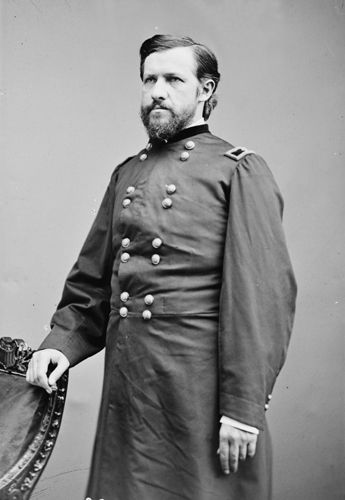
General Thomas Ewing during the Civil War.
“II — All grain and hay in the field or under shelter, in the districts from which the inhabitants are required to remove, within reach of military stations, after the 9th day of September next, will be taken to such stations and turned over to the proper officers there; and report of the amount so turned over made to district headquarters, specifying the names of all loyal owners, and the amount of such produce taken from them. All grain and hay found in such district after the 9th day of September next, not convenient to such stations, will be destroyed.
“III — The provisions of General Orders No. 10 from these headquarters will be at once vigorously executed by officers commanding in the parts of districts, and at the stations, not subject to the operation of Paragraph I of this order — and especially in the towns of Independence, Westport, and Kansas City.
“IV — Paragraph 3, General Orders No. 10, is revoked as to all who have borne arms against the government since the 20th day of August 1863.”
General Order No. 10 provided for an escort to all loyal persons desiring to remove to a military post in the district; ordered the arrest of all persons, except women, who as heads of families, gave aid to guerrillas; wives and children of known guerrillas, women, who as heads of families willfully engaged in assisting guerrillas, were to remove out of the district unmolested, and if they refused to remove they were to be taken to Kansas City for shipment to some point within the Confederate lines.
The clause rescinded by Paragraph 4 of General Order No. 11 provided that persons who laid down their arms and surrendered themselves to be banished with their families were sent to such point as the commanding officer might direct.

Missouri Border Ruffians, also called Bushwhackers.
General Order No. 11 aimed to prevent guerrillas, particularly Quantrill’s Raiders, from finding lodging, food, and supplies among the Confederate sympathizers in western Missouri. The order served a good purpose in breaking up the rendezvous of the guerrillas and checking their forays into Kansas. Loyal men in both states applauded General Thomas Ewing for his courage and foresight in issuing it.
In enforcing the order, Ewing commanded his men to avoid looting or depredations. However, he could not control his troops, many of whom were Kansans eager to exact any revenge upon their Missouri neighbors. The soldiers wasted no time wreaking havoc on the area, stealing property, and burning homes and outbuildings. As the Missouri residents fled, all that was left of many once-fertile farms were charred chimneys and burned fields.
Ironically, Ewing’s order failed miserably, having the opposite effect. Though Missouri had always held numerous Confederate sympathizers, those who would not have aided the guerillas in the past were so angered by the destruction by the soldiers that they began to assist them. Those who had helped went out of their way to assist even more.
Though the Federal Government sustained the order, Ewing also took much criticism from both politicians and his military superiors. Some months later, he issued General Order No. 20, which permitted loyal citizens to return to their homes and the men to organize companies for defense.
After the Civil War, Ewing would continue to feel the effects of his order when, at the Democratic National Convention, which met in New York City on July 6, 1868, he was defeated for nomination for Vice President.
Compiled by Kathy Alexander/Legends of America, updated February 2024.
About the Article: Some of this historic text was published in Kansas: A Cyclopedia of State History, Volume I; edited by Frank W. Blackmar, A.M. Ph. D.; Standard Publishing Company, Chicago, IL 1912. However, the text on this page has been heavily edited, with many additions.
After General Order #11 came General Order #20


Above Captain P. McClanahan writes to Abram Comingo and says Red Crenshaw’s house was burned for the hell of it. Red is Aaron L.H. Crenshaw.
Captain Perry D. McClanahan served in the Civil War for the Union Army as a Captain of Co. EC , 2nd Regiment, Missouri State Militia Cavalry from 1861-1865.
Abram Comingo He moved to Independence, Missouri in 1848, was delegate to the Missouri State convention in February 1861 which decided that Missouri would remain in the Union in the American Civil War; appointed provost marshal of the sixth district of Missouri in May 1863; elected recorder of deeds of Jackson County, Missouri in 1868.
Please check this link out to the Kansas City Public Library with a treasure trove of letters, maps, etc. for more info about the Civil War here in our area.
Home Page | Civil War on the Western Border
Full List of Quantrill Raiders at Link Below.
Surrounding Areas of Interest
If you have traveled 40 Highway going into Blue Springs, you undoubtedly have seen the Blue Springs Cemetery on your left. Here is a story of the Harris family and that area.
Family History of
William HARRIS and Rhoda Effaniah BURNETT
and Brief Biological Sketches of Their Fifteen Childrensubmitted by BouchnVic@aol.com
Prepared for the Harris Reunion, Lee’s Summit, Missouri.
(Updated April, 2002)
Rhoda Effaniah Burnett was born 22 June, 1800, Patrick County, Virginia, the daughter of Jeremiah Burnett, III and his wife, Effaniah “Effie” Crowley. Jeremiah Burnett, III was the son of Jeremiah Burnett, II. The name of his mother is not known at this time. Jeremiah Burnett, III was born ca. 1761 in Albemarle County, Virginia. He served in the 10th Virginia Regiment in the Revolutionary War. Effaniah Crowley was born ca. 1765, in Halifax County, Virginia, and was the daughter of Samuel Crowley and Elizabeth Strong. Samuel Crowley was serving as a scout under General Andrew Lewis in a fight with hundreds of Indians led by the Shawnee Chief Cornstalk during Lord Dunmore’s War, at Point Pleasant, now West Virginia. He was one of the first men killed in this battle on 10 October, 1774.
Rhoda Effaniah Burnett age 17, was married 18 August, 1817, Patrick County, Virginia, to William Harris, age 21. He was born 14 April, 1796, Patrick County, Virginia, the son of Reuben Harris, and Margaret Anne McAlexander. She was the daughter of William McAlexander, and was born ca. 1793. On 16 September, 1830, Patrick County, Virginia, Margaret Harris signed a dower relinquishment. At this writing, no further records have been found by researchers. Reuben Harris was born ca. 1760, Buckingham County, Virginia, the son of William Harris and Sarah Steele. He served in the 6th Virginia
Regiment during the Revolutionary War. Reuben Harris died 16 March, 1842, in Jackson County, Missouri.
Early in the 1800’s emigration to the Midwest from the eastern states had begun. In 1821 Missouri had been the 24th state admitted to the Union. By government treaty in 1825, the Osage Indians had relinquished a strip of land twenty-four miles wide along the western side of Missouri from the Missouri River to the Arkansas River. On 15 December, 1826, the General Assembly of the State of Missouri established the County of Jackson. Emigrants had already started coming into the region, commonly referred to
as the “Blue Country”. As word got back to the eastern states that this
area would soon be open for settlement, wagon trains began bringing
settlers from Virginia, Tennessee, Kentucky, and other states. Among those who decided to emigrate from Virginia to Missouri were Reuben Harris and several of his children. Two sons and a daughter were already established in Jackson County, Missouri. Court records in Patrick County, Virginia in 1830 show the sale of property by several members of the Harris family. William Harris was one of the sons of Reuben Harris to make the decision to emigrate to Missouri. By this time, seven children had been born to William and Rhoda Harris.
In 1830, Independence, Missouri, was a small settlement of log cabins, with a population of nearly 2,000 persons. It had been named the county seat of Jackson County. There was little traffic on the nearby Missouri River, and there were no roads, only rough trails. This was the destination of the wagon train carrying Reuben Harris, several of his married children and their families, several unmarried children, slaves and other Virginia families. They reached Independence, Missouri, in the fall of 1830. William and Rhoda Harris and their seven children were in this group. The first winter William Harris rented the Milton farm near Independence. The next year, he and his family moved to the area where the present town of Blue Springs, Missouri, is located. By May, 1832, William Harris had obtained a land patent on 120 acres of land in Sni-a-bar Township, Jackson County:
forty acres in the SE ¼ NE ¼, Sec. 34, Twsp. 49, R. 31, and eighty acres in
the W1/2 NW¼, Sec. 35, Twsp. 49, R. 31. Through the years, William and Rhoda Harris added to their holdings. The family farmed the land. Rhoda Harris cultivated an extensive herb garden that provided medicinal plants, which she used in treating family and neighbors. There were no doctors. Rhoda Harris was often called upon to treat sicknesses, and to act as midwife. William Harris and his sons were fond of hunting, and William was a part-time preacher. The Harris family were Baptists. By 1845, eight more children had been born to this couple. All but one of the fifteen children grew to maturity. One family story relates how proud William and Rhoda
Harris were when all twelve of their sons were seated together at a dinner table. Tragedy soon struck the family with the death of the baby, Lewis Franklin. He was born 6 May, 1845, and died 3 August, 1845. He was buried on a sunny slope of the farm. As later deaths occurred, this became the family burial ground. On 28 March, 1847, William Harris died of cholera and was buried beside his infant son. The following year on 28 June, 1848, Jeremiah Burnett died at the age of 99. He was buried there beside William Harris and Lewis Franklin Harris. Rhoda Harris and her son, Samuel Birks, had gone to Virginia and brought her father back to Jackson County, Missouri. He had several other children living in the area. Years later Rhoda Harris donated this 1 1/2 acres of land to the city of Blue Springs, Missouri. This was the beginning of the Blue Springs City cemetery. After the death of her husband, Rhoda Harris continued to manage the farm with the help of her seven children and several slaves. She had strong sympathies with the Confederacy, and she gave aid to Quantrill’s men who
supported the South and made eastern Jackson County, Missouri, their base of operations. One son, Marion Lee Harris, served in Company A, 9th Missouri Infantry, (Confederate). Late in her life Rhoda Harris experienced another tragedy when she lost the sight in one eye. She died 9 September, 1878, age 78 years, 2 months and 15
days. She was buried beside her husband and other family members on the land she had donated to the city of Blue Springs, Missouri.
The will of William Harris was offered for probate on 10 April, 1847. His property was left to his wife, Rhoda Harris, for as long as she remained his widow or until death. It was then to be divided equally among his children. Rhoda Harris died intestate, so the conditions of her husband’s will were in effect. On 10 October, 1878, a petition (Cause No. 795) was filed in the Special Law and Equity Court of Jackson County, Missouri at Independence. All living children and heirs of deceased children were named. Due to the large number of heirs, many of them not living in Missouri, the Court was asked that the real estate be sold and the proceeds divided according to law. Before this could be done, Marion Lee Harris, one of the plaintiffs, was killed in a cyclone. This delayed the settlement of the estate for several months. The partition sale was held in July, 1880. William and Rhoda Harris were the parents of fifteen children and they had ninety-nine grandchildren. Thousands of Americans are descendants of this
pioneer couple.
Children of William and Rhoda Effaniah Burnett Harris:
Jeremiah Alexander Harris 1818 — 1848
Nancy Martha Harris 1820 — 1886
Fleming Saunders Harris 1822 — 1886
Isham Burnett Harris 1823 — 1852
Reuben Crowley Harris 1825 — 1893
William Greenville Harris 1828 — 1898
Samuel Birks Harris 1830 — 1923
John Hardin Harris 1832 — 1918
Doctor Lawrence Harris 1833 — 1913
Judith Ann Elizabeth Harris 1835 — 1869
Thomas Columbus Wilson Harris 1837 — 1857
James Marshall Harris 1839 — 1914
Rhoda Effaniah Harris 1841 — 1896
Marion Lee Harris 1843 — 1879
Lewis Franklin Harris 1845 — 1845
1 — JEREMIAH ALEXANDER HARRIS (“JESSIE’)
Jeremiah Alexander Harris was born 24 March, 1818, Patrick County,
Virginia, the first of 15 children born to William and Rhoda Harris. He was twelve years old when his parents emigrated to Jackson County, Missouri. He helped his mother make bricks out of water and mud when their home was built and he helped her plant the black locust trees that she brought from Virginia. Jeremiah Harris was married 20 December, 1838, Jackson County, Missouri, to Elizabeth Lane Gibson. She was born 24 August, 1822, at Bowling Green, Kentucky, the daughter of Silas Harvey Gibson and Elizabeth Slaughter. Jeremiah and Elizabeth Harris settled on land near his parents in Sni-a-bar Township, Jackson County, Missouri. Four children were born to
this couple. Jeremiah Harris died 24 August, 1848, at the age of thirty
during a cholera epidemic. It is probable the he was buried in the family
burial ground on his parents’ farm. Elizabeth Gibson Harris and her
children were living in her father’s household when the 1850 Census for Jackson County, Missouri was taken. She married 2/ Clairborne Webb on 5 December, 1852, and they had several children. Elizabeth Harris Webb died 10 September, 1880, and was buried in the Slaughter Cemetery, Sni-a-bar Township, Jackson County, Missouri.
Silas Turner Harris, son of Jeremiah A. and Elizabeth Harris was in
Confederate Service under General Jo Shelby for two years during the Civil War.
2 — NANCY MARTHA HARRIS
Nancy Martha Harris was born 8 August, 1820, Patrick County, Virginia, the first of three daughters born to William and Rhoda Harris. At the age of ten she emigrated to Jackson County, Missouri, with her parents. She was married 26 January 1837, Jackson County, Missouri, to William Taylor Burrus. He was born 22 January, 1811, in Virginia, son of George Burrus and Elizabeth M. Taylor. Nancy and William T. Burrus lived two miles west of Blue Springs, Missouri in Sni-a-bar Township. Eleven children were born to them, nine of whom reached maturity. When the youngest child was only eleven days old, William T. Burrus died on 2 November, 1858. Burial was in Blue Springs Cemetery. Nancy M. Burrus continued farming with the help of her children and family members. During the Civil War she was exiled under
Order #11, and went to LaFayette County, Missouri, near Lexington, but later returned to Jackson County. One son, James Madison Burrus, served under General Sterling Price and General Jo Shelby in Confederate Service during the Civil War. After the war he returned to Jackson County, Missouri, and for a year or two helped his mother on the farm. Nancy M. Harris married 2/ Andrew Jackson Smith who was still living by July, 1880, when the Harris estate was settled. Nancy Martha Harris Burrus Smith died 24 April, 1886.
3 — FLEMING SAUNDERS HARRIS
Fleming Saunders Harris was the third child born to William and Rhoda
Harris, 22 February, 1822, Patrick County, Virginia. At the age of eight he emigrated to Jackson County, Missouri, with his parents, where they settled in Sni-a-bar Township. He was married 15 February, 1844, to Mary Jane Slaughter. She was born 22 June, 1827, in Virginia, the daughter of Josiah Slaughter and Elizabeth Koger. Fleming S. and Mary Jane Harris were parents of 13 children, 11 of whom grew to maturity. The Harris farm was located in Van Buren Township, Jackson County, Missouri. Fleming S. and Mary Jane Harris were charter members of the New Liberty Baptist Church of Jesus Christ of New Liberty, which was near their farm. During the Civil War the Fleming S. Harris family was exiled under Order #11, and went to Carroll County, Missouri. Their thirteen-year-old son, John Reuben, made several
dangerous trips back to the Jackson County farm to get food supplies for the family. While exiled, there was much digging on the farm by people who thought Fleming Harris had buried a large amount of money before leaving. Several years later, having returned to his farm, Fleming S. Harris was kicked by a mule. This resulted in his death 19 November, 1885, at age 63 years, 8 months, and 27 days. He was buried in the Koger Cemetery, Van Buren Township, Jackson County, Missouri. (This cemetery is also called the Russell Cemetery and the New Liberty Cemetery). Mary Jane Harris died 21 February, 1894, at age 66 years, 7 months, 29 days, and was buried in the Koger Cemetery beside her husband.
4 — ISHAM (ISOM) BURNETT HARRIS
Isham ( Isom ) Burnett Harris was born 22 November, 1823, Patrick County, Virginia, the fourth child of William and Rhoda Harris. At the age of seven he emigrated to Jackson County, Missouri, with his parents. He was married 14 September, 1843, Jackson County, Missouri, to Margaret Johnson. She was born 28 October, 1825 in Virginia, the daughter of Larkin Johnson and Sarah Harris. This couple lived in Sni-a-bar Township, Jackson County, Missouri.
Isham B. Harris died 6 April, 1852, at age 28 years, 4 months, and 14 days. He was buried in the Harris family burial ground, now part of the Blue Springs Cemetery. Isham B. Harris died intestate, leaving three children. Family bible records show that a fourth child, Isom DeWar Harris, was born 5 March, 1852. This child was not listed as an heir in the estate proceedings, filed 13 April, 1852, Jackson County, Missouri, so he must have died shortly after birth and before his father’s death. Margaret Harris married 2/ William H. Selby. Margaret Harris Selby died 17 November, 1901.
5 — REUBEN CROWLEY HARRIS
Reuben Crowley Harris was born 29 December, 1825, Patrick County, Virginia, the fifth child of William and Rhoda Harris. At five years of age he emigrated with his parents to Jackson County, Missouri. He was married 20 February, 1850, to Nancy Jane Moultrie in Jackson County, Missouri, daughter of William Moultrie and Mary Elizabeth Fitzhugh of Virginia. In 1852 this couple went by ox train to California. According to family tradition, when they left Independence, Missouri, Nancy Jane Harris was ill and was not expected to live to reach California, but in a month or two she was able to sit up. Long before they reached California, she was doing her share of the camp work. This couple farmed in California for many years. They had four children. Reuben Crowley Harris died 29 March, 1893. Both he and his wife were buried in California.
6 — WILLIAM GREENVILLE HARRIS
William Greenville Harris was born 13 April, 1828, Patrick County,
Virginia, the sixth child of William and Rhoda Harris. At the age of two he emigrated with his parents to Jackson County, Missouri, where they settled in Sni-a-bar Township. The Harris children attended the old Blue Springs log schoolhouse located across the road east of the Harris farm. William Greenville Harris was married in November, 1859, to Martha Ann McPherson. She was the daughter of Murdock McPherson and Elizabeth Ann Fitzhugh. Her brother, Daniel McPherson, married Rhoda Effaniah Harris, sister of William G. Harris. William G. and Martha A. Harris owned several hundred acres of
land just north and west of his parents’ home place in Sni-a-bar Township The house stood on a slope north of the railroad track that runs to Blue Springs. Part of this farm land became Lake Tapawingo. William G. and Martha A. Harris had eight sons. One son died in infancy and another died at the age of 16. Three sons never married. Martha Ann Harris died 5 August, 1887, and William Greenville Harris died 13 August, 1898. Both are buried in the Harris family lot at Blue Springs Cemetery. Six of their sons are also buried there.
7 — SAMUEL BIRKS HARRIS
Samuel Birks Harris was born 12 May 1830 Patrick County, Virginia, the seventh child of William and Rhoda Harris. At the age of six months, he was taken by his parents to Jackson County, Missouri, where they settled in Sni-a-bar Township. The Harris family was the first to settle in this area. Samuel Birks attended the old log school near his family’s farm. His father died when he was 17 years of age. The following year he and his mother made a trip to Virginia and brought back her father, Jeremiah Burnett. He had served in the Revolutionary War. The life of Samuel Birks Harris has been well publicized, with numerous printed accounts of his trip across the plains to California with an ox team during the “Gold Rush” days, and other
interesting stories. After several years he returned to Jackson County,
Missouri, and became a farmer. He married 1/ 10 August, 1860, Jackson County, Missouri, to Parlee Webb. She was born 22 October, 1839, Oak Grove, Missouri, daughter of John P. Webb and Elizabeth Birdwell. Eight children were born of this union. During this time the Samuel Birks Harris family had to leave Jackson County, Missouri, after Order #11 was issued in August, 1863. They went to Logan County, Illinois, and remained there until after the war, then spent a number of years in Bates County, Missouri, before returning to Jackson County, Missouri Parlee Webb Harris died 18 March, 1877, after the birth of her son, Albert C. Harris. Samuel Birks Harris married 2/ Cornelia McClintock. She was born 10 January, 1855, Hancock County, Illinois, the daughter of Glasgow McClintock and Nancy
Imen. Four children were born of this union. Samuel Birks Harris died 2
March 1923, at the age of 92 years, nine months, and twenty days. Cornelia McClintock Harris died 8 February 1938, at Greenwood, Missouri.
8 — JOHN HARDIN HARRIS
John Hardin Harris was born 10 July, 1832, the eighth child of William and Rhoda Harris. He was the first of their children to be born in Missouri. He grew up on the family farm in Sni-a-bar Township, Jackson County, Missouri, and attended the old log school near the farm. John Hardin Harris was nearly 15 years of age when his father died. For several years he helped his mother work the farm, then worked as a farm hand until he had saved enough money to buy land of his own near Blue Springs, Missouri He was married 1/ 28 June 1853, to Louisa Bridges, the daughter of James Bridges and Annie Powell. Louisa Bridges Harris died in April. 1859, leaving three children. John H. Harris married 2/ 18 October, 1860, Louisa Jane Powell.
She was born 6 May, 1842, the daughter of Absalom Powell and Elizabeth Rice. Her grandfather was Joseph Powell, a Revolutionary War soldier who died in Jackson County, Missouri in the early 1830’s. For two years , during the Civil War, the Harris family lived in Colorado. After the war they returned to Missouri and bought land eight miles east of Lee’s Summit, Missouri. John H. Harris farmed extensively and prospered. This couple had eight children and Louisa Harris helped rear her three stepchildren. In 1897. the Harris family moved near Lee’s Summit, Missouri and John H. Harris established a park, stocking it with deer. The deer park became a tourist attraction. After his death 23 September, 1918, the deer herd was sold. Louisa Powell Harris died 7 June, 1936.
John H. Harris, his son, James Fleming Harris, and his brother, Samuel
Birks Harris, were the originators of the Harris Family Reunion. Some local family members had been gathering annually in reunion. The Harris brothers wanted to honor their parents, William and Rhoda Harris, in a special way by having an annual reunion of all their descendants. At a meeting of family members on 6 May, 1911, by-laws were drawn up for the organization to be called “Descendants of William and Rhoda Harris”. The first reunion meeting was held 11 May, 1911, with a fish fry at the farm home of John Hardin Harris near Lee’s Summit, Missouri. A Constitution and By-Laws for this organization were formally adopted by nearly 200 persons who were in
attendance. This has been an annual event since that time. The 91st Reunion was held at Harris Memorial Park, Lee’s Summit, Missouri on September 9, 2001.
9 — DOCTOR LAWRENCE HARRIS
Doctor Lawrence Harris was born 12 November, 1833, Jackson County, Missouri, the ninth child of William and Rhoda Harris. He grew up on the family farm and attended school for short periods of time. In 1852 he joined a wagon train going to California. On the journey, Doctor and his brothers, Reuben Crowley Harris and Samuel Birks Harris, drove an ox team. Family stories tell of the long trip, encounters with hostile Indians, a cholera outbreak, and other harrowing experiences. In California Doctor Lawrence Harris worked around sawmills and engaged in freighting to the mines. He built up a reputation as one of the best ox drivers in the state.
About 1884 he bought a ranch adjoining that of his brother, James Marshall Harris, and set out an apple orchard. Doctor Lawrence Harris married Nettie Milburn in 1886. A son, John Marshall Harris, was born 17 February, 1887. The marriage lasted a short time. Doctor Lawrence Harris raised horses, cattle, and very fine strain of cattle dogs, which were in great demand by cattlemen. In 1906 Doctor Lawrence Harris was called to San Francisco to visit a dying friend. On April 18, 1906, he was caught in the San Francisco earthquake, but escaped without injury. Throughout his life, Doctor Lawrence Harris held a firm belief that he had mystical healing powers. There were those who believed he had cured them. In the summer of 1908, while riding after cattle, he was struck in the head with the end of limb, which made an ugly wound. He tried to heal his wound by laying on hands but
before long cancer had developed. He suffered for five years and died 11 July, 1913. He was buried in a small private cemetery on the ranch of his brother, James Marshall Harris, in Mariposa County, California. John Marshall Harris, son of Doctor Lawrence Harris, enlisted in the U. S. Navy in 1918, and was stationed aboard the U. S. cruiser, Frederick, convoying troops to France. He was stricken with Spanish influenza and died. Before his death he had established contact with his mother and provided for her for the rest of her life.
10 — JUDITH ANN ELIZABETH HARRIS
Judith Ann Elizabeth Harris was born 3 January, 1835, Jackson, County, Missouri, the tenth child of William and Rhoda Harris. She was twelve years old when her father died. Her mother raised her in Jackson County, Missouri. Judith Ann Harris was married 4 December 1851, to Benjamin Franklin Ingram. She was his second wife. He was born in 1821 in Virginia. Judith and Benjamin Ingram had four children; two died in infancy and one died at the age of five years. Judith A. Ingram died 13 October, 1869. Benjamin Franklin Ingram died 31 January, 1878, at Verdi, Nevada. The couple predeceased Rhoda Harris, and as a result, their daughter, Rose C.
Ingram received a share of the Rhoda Harris estate.
11 — THOMAS COLUMBUS WILSON HARRIS
Thomas Columbus Wilson Harris was born 2 December, 1837, Jackson County, Missouri, the eleventh child of William and Rhoda Harris. His father died when he was ten years old. He helped on his mother’s farm and attended school nearby. At the age of nineteen, while plowing with an ox team, he was dragged some distance and was fatally injured. Thomas Columbus Wilson Harris died 13 June, 1857. He was buried in the family burial ground on their farm, which was later to become the Blue Springs Cemetery.
12 — JAMES MARSHALL HARRIS
James Marshall Harris was born 21 July, 1839, Jackson County, Missouri, the twelfth child of William and Rhoda Harris. He was seven years old when his father died. He spent his early years on the family farm in Jackson County, and attended school near the farm. In May, 1857, at the age of seventeen, he started to California with his youngest sister, Rhoda E, and her husband, Robert McPherson, who was captain of the wagon train. He and his friends had an ox team but walked most of the way from Independence, Missouri, to San Francisco Bay, California. The wagon train was raided by Indians and stock was stolen, adding to the hardships and delays of the journey, which ended in September, 1857. The McPhersons settled in Livermore Valley, California. James Marshall Harris lived with them for two
years. He bought books to further his limited education and was an avid reader throughout his life. About 1870 he moved to Mariposa County, California, and bought the squatter’s rights on a well-watered meadow clearing. He set out an orchard of varied fruits and apples. His mother, Rhoda Harris, sent him scions (cuttings) of old varieties of fruit trees. Through the years he expanded his acreage by homestead, and preemption, and set out more orchards and vineyards. He was one of the first commercial orchardists in California. He was well known in the area for his fruits and melons and as a horticulturist. In 1879 he moved from his little log cabin into a new home. He was still a bachelor. In 1883 he returned to Jackson County, Missouri for a visit. He had been away for nearly 25 years. His dearly beloved brother, “Tommie”, (Thomas Columbus Wilson Harris), had been killed shortly after James Marshall left for California. While visiting with relatives in Jackson County, Missouri, he met Alice May Hunter, and on 5 September, 1883, they were married. Alice May Hunter was born 28 April,
1857, Jackson County, Missouri, the daughter of Samuel Robert Hunter. James Marshall Harris and his bride returned to California. They had eight children, including twin daughters, Jessie Harris Visher, and Bessie Harris Sowers, who provided stories about the Harris family in California. James Marshall Harris died 16 May, 1914. He was buried in the family cemetery on his farm in Mariposa County, California, beside his brother Doctor Lawrence Harris. His widow, Alice M. Harris survived him.
13 — RHODA EFFANIAH MARGARET HARRIS
Rhoda Effaniah Margaret Harris was born 25 August, 1841, Jackson County, Missouri, the third daughter of William and Rhoda Harris. She was named after her mother. She was married 5 May, 1856, Jackson County, Missouri, to Daniel Robert McPherson. He was born 26 December, 1835, son of Murdock McPherson and Elizabeth Ann Fitzhugh. Rhoda E. Harris was 15 years of age when she married. In May, 1857, the McPhersons left Independence, Missouri,
by ox train. Robert McPherson was captain of the train. According to family legend the wagon train reached San Francisco Bay, where the oxen refused to drink the salt water. This caused the weary travelers to realize they had reached the end of their long journey. The McPhersons settled in Danville in Contra Costa County, California, where they farmed several hundred acres of land for many years. Eleven children were born to this couple. Rhoda E. McPherson died 4 July, 1896. Daniel Robert McPherson died 26 December, 1904.
14 — MARION LEE HARRIS
Marion Lee Harris was born 16 April 1843, Jackson County, Missouri, the fourteenth child of William and Rhoda Harris. His father died when he was four years of age. He grew up on the family farm. Marion Lee Harris served as a Private in Co. A, 9th Missouri Infantry, (Confederate) during the Civil War. He surrendered at New Orleans, Louisiana. 26 May, 1865, and was paroled 7 June, 1865, at Alexandria, Louisiana. He returned to Jackson County, Missouri and settled near Blue Springs. He was married August, 1868, to Phebe Jane Wright. She was born 12 June, 1852, the daughter of Jonathan Wright and Lydia Ann Manker. This couple had four children. On 30 May, 1879, about 7:00 P. M., a devastating cyclone swept across eastern Jackson County, Missouri, causing tremendous property damage. The cyclone approached the farm of Marion Lee and Phebe Harris. They had little
warning, and while attempting to reach shelter, the family became
separated. The wind swept nine-year- old Frank into a straw rick. He was badly bruised and burned. Eight year old Lillie was killed instantly.
Marion Lee and Phebe Harris were crushed and both died within a short time. The baby, Earnest, died a few weeks later, as a result of the incident. Two children, Frank and Lucy Ann, survived this tragedy.
15 — LEWIS FRANKLIN HARRIS
Lewis Franklin was the last child, and twelfth son, born to William and
Rhoda Harris. He was born 6 May 1845, at the Harris farm home, Sni-a-bar Township. Lewis Franklin Harris died 3 August, 1845, age 3 months, 7 days. He was buried on a sunny slope of the Harris farm. This first grave was the beginning of what is now the Blue Springs, Missouri, Cemetery. This was the first baby Rhoda Harris lost. A family story tells of the pride William and Rhoda Harris felt after the birth of Lewis Franklin, when all twelve of their sons were seated with them at the dinner table.
Prepared by:
Mary McCarty Harris, Historian for Descendants of William and Rhoda Harris
411 South Bleckley Drive
Wichita, Kansas 67218-1524
E-mail: mmchar@earthlink.net
Submitted by Rhoda’s third great-grandson, Marland R. Boucher
